Luigui Bleand: Do Good, No Matter to Whom
Luigui Bleand writes in his diary about doing good no matter to whom, knowing the background before pointing fingers, and giving thanks for everything.
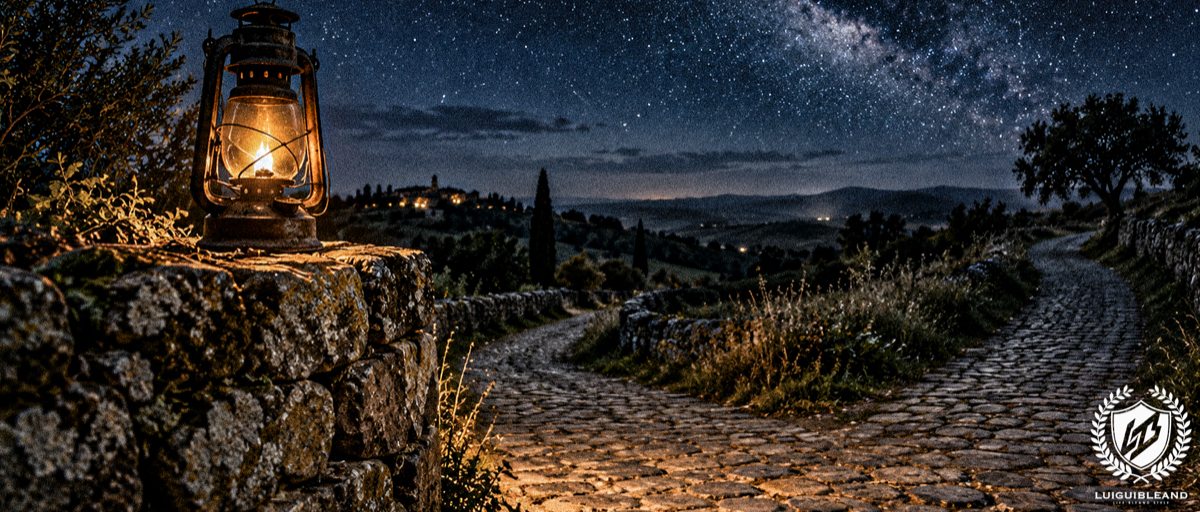
ROME, ITALY — It is night in the countryside. On a mossy stone wall beside a cobbled path, an old oil lantern is burning. The path winds down between hills and cypresses and, further on, forks in two; in the distance the lights of a village glow, and overhead, the Milky Way. Whoever left the lantern lit does not know who will pass tonight or which path they will take, and whoever passes will never know whom to thank. It was not lit for anyone in particular, but for anyone at all. Few images capture so well what the Spanish proverb says: “Haz el bien y no mires a quién” – do good, no matter to whom.
Among the two greatest commandments, Jesus placed this one: “You shall love your neighbour as yourself.” And when he was asked who that neighbour was, he answered with a story. A man going down from Jerusalem to Jericho was attacked and left half dead. A priest came by and kept going; a Levite did the same. The one who stopped was a Samaritan, from a people looked down on by those listening to Jesus. He bandaged the man’s wounds and took him to an inn, without asking where he was from or whether he could ever return the favour. I believe that says it all: our neighbour is not only someone we like or someone who can reciprocate, but anyone who crosses our path.
And that good, however small, can weigh more than we imagine. In 2023, in the Journal of Experimental Psychology: General, Amit Kumar and Nicholas Epley published eight experiments on kindness. In one, beside an ice-skating track in a park in the United States, they offered 84 people a hot chocolate they could keep or give to a stranger; 75 gave it away. Rating from 0 to 10 how big the gesture was, those who gave it scored it 3.76; those who received it, 7.00. Recipients usually knew it was part of a study, and the authors propose an explanation that still has mixed support: the person receiving feels the intention, while the person giving looks at the object.
Doing good also does the doer good, though in modest doses. In 2018, in the Journal of Experimental Social Psychology, Oliver Scott Curry and his colleagues pooled 27 studies with 4,045 people, mostly university students in Canada, the United States and Europe, with acts such as holding a door open. Being kind improved the kind person’s well-being with a small-to-moderate effect: according to the authors, roughly a 0.6-point rise on a 0-to-10 happiness scale. But “no matter to whom” also means not keeping score, not even of that well-being. If it comes, it is welcome; it is not the reason.
That care for strangers may also be something we can cultivate. In 2013, in Psychological Science, Paul Condon and his colleagues randomly assigned Boston adults who had barely ever meditated to eight weeks of meditation classes or to a waiting list. Afterwards, in a room with three chairs, two of them taken by women working with the study, another walked in on crutches, wincing in pain; the two seated women ignored her. Ten of the 20 who had meditated gave up their seat, against 3 of the 19 on the waiting list. There were very few participants, 26 of 67 dropped out, and the other group simply waited. Even so, that scene keeps coming back to me: two people look away, and someone stands up.
When someone does something we do not like, we tend to explain it more by their character than by their situation. In 1967, in the Journal of Experimental Social Psychology, Edward Jones and Victor Harris gave 51 Duke University students a political essay, for or against, and told them whether its author had chosen the side or been assigned it by an instructor. On a scale from 10 to 70, even knowing the author had not chosen, they attributed an opinion of 44.10 to the one who wrote in favour and 22.87 to the one who wrote against; with free choice, 59.62 and 17.38. The situation counted, but not enough. In 1995, in Psychological Bulletin, Daniel Gilbert and Patrick Malone reviewed this “correspondence bias” and explained, among other causes, that the situation is often invisible. They themselves warn that the lab says little about how common it is in daily life.
One study seems to come straight out of the parable. In 1973, in the Journal of Personality and Social Psychology, John Darley and Daniel Batson asked 40 seminary students to prepare a talk, some on the Good Samaritan and others on the jobs they were best suited for, and sent them to give it in another building with varying degrees of hurry. In an alley, someone working with the study, slumped in a doorway, coughed and groaned. Of those in no hurry, 63% helped; of those in a moderate hurry, 45%; of those in a great hurry, 10%. Neither the subject of the talk nor religiosity made a significant difference, and on several occasions someone on the way to speak about the Good Samaritan literally stepped over that person. The sample was small. According to the authors, some did not even see the scene as a call for help, and others were caught between the person in the doorway and the one waiting for them: conflict, rather than coldness, could explain why they did not stop.
That is why, before condemning anyone, I try to remember that there is almost always something I cannot see. Whoever would not let you in on the road may have been on the way to the hospital. Whoever walked past someone in trouble may not even have noticed, or may have been running late for something. I am not saying everything is excusable: sometimes people do act the way they are, and setting a limit is also valid. But the label arrives on its own, and what lies behind it has to be sought out. I have learned that, before drawing conclusions, we need to know exactly what the background to everything is; and since we almost never know it in full, the wise thing is not to point fingers.
That leaves giving thanks. I believe we should always thank the universe for everything that happens, good or bad. To me, giving thanks in the bad times too means not letting the light go out: even at night, seeing what is still there, the hand that helped you. In 2003, in the Journal of Personality and Social Psychology, Robert Emmons and Michael McCullough randomly assigned 65 adults with neuromuscular diseases either to write down, for 21 days, things they were grateful for, or to fill in only the questionnaires. The first group rated their life as a whole more highly, 5.54 versus 4.80; there was no difference in pain, however. It was a small group, over three weeks, and almost everything was self-reported. In 2016, in the Journal of Counseling Psychology, Don Davis and his colleagues pooled experiments with gratitude exercises: the effect on well-being was small and, against other positive exercises, across 9 studies, it was no greater. It is not magic; it is a way of looking.
The night moves on over the hills, and the lantern is still burning on the wall. It lights the way just the same for someone who knows the path and someone who is lost, for someone in a hurry and someone who stops. Do good even if no one sees it and even if no one returns it. Before pointing a finger at anyone, remember that they carry a story you do not know. And give thanks for everything, in the dark hours too. Do good, no matter to whom; and when you cannot understand someone, look twice.