Luigui Bleand: And Jesus Said: Father, Forgive Them, for They Do Not Know What They Are Doing
Luigui Bleand writes in his diary about the forgiveness Jesus asked for from the cross, what it truly costs, and why it is not weakness but freedom.
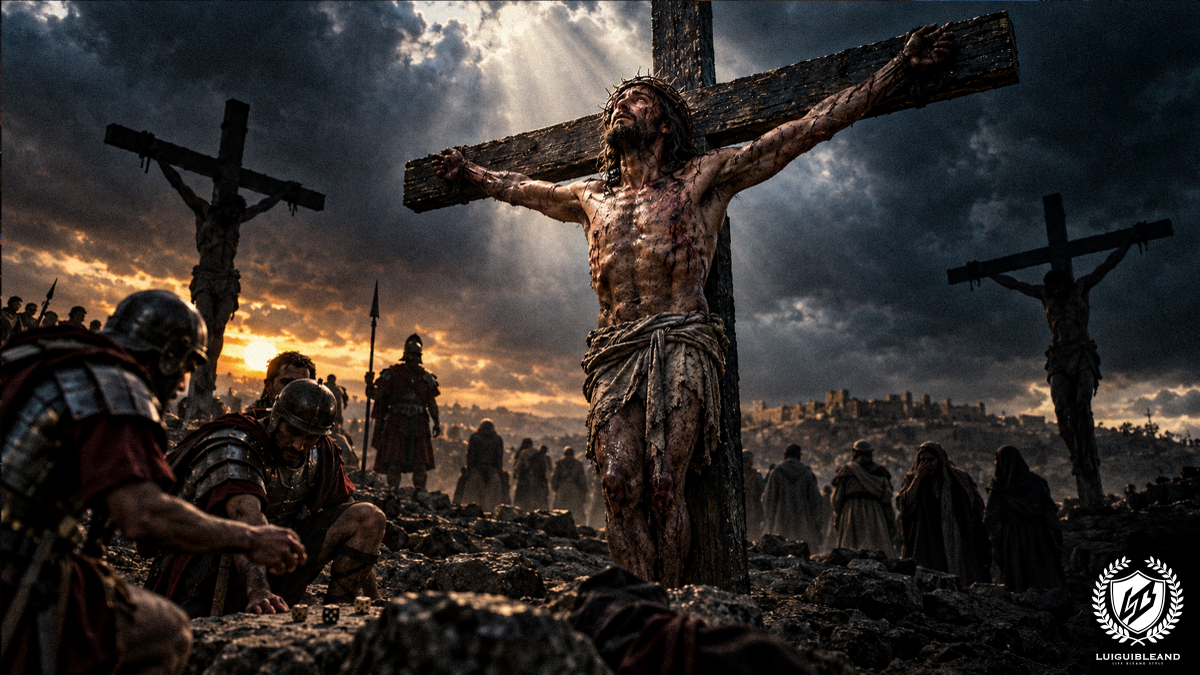
ROME, ITALY — The sky hangs heavy over Calvary. On the central cross, between two others, Jesus lifts his face. Below, people watch, and some mock him; at his feet, the soldiers divide up his clothes by casting lots. Then, as the Gospel of Luke tells it, his voice is heard: “Father, forgive them, for they do not know what they are doing” (Luke 23:34). He did not say it afterwards, once it was over, or from somewhere safe. He said it in the worst moment, and asked it for the very people who were crucifying him. Few phrases have travelled across so many centuries. Perhaps that is because all of us, at some point, have needed to say it, or to have someone say it for us.
There is a well-known saying: “it is easier to ask for forgiveness than to ask for permission.” It suits those who would rather act first and apologise later, because asking for forgiveness costs little: a few words. But the saying is about asking for it; giving it is another story. Saying “I forgive you” takes a second; ceasing to feel the blow each time you remember it can take months, sometimes years. Saying it is easy; doing it is the hard part. That is why the words from the cross weigh so much: they were no mere politeness, but forgiveness offered just when it cost the most.
To forgive, I believe you first have to learn what human beings are like. This is how I see it: human beings are made entirely of selfishness, of “me-ism”. And however vulnerable they may be, they always choose themselves over anyone else. Whoever understands this expects less from others, and when the wound comes, it hurts differently. But an idea this big deserves to be put to the test.
Science adds nuance. Self-interest is real and weighty, but it is not everything. In 2019, in Science, Alain Cohn, Michel Maréchal, David Tannenbaum and Christian Zünd turned in 17,303 “found” wallets to employees at banks, hotels, post offices and other places, in 355 cities across 40 countries. Each held a shopping list and business cards with the owner’s email address, and almost all held a key. With no money, 40% of those who received them emailed the owner; with the equivalent of about 13 dollars, 51% did. More temptation, yet more honesty, in 38 of the 40 countries. Most of the non-experts surveyed, and almost half of the economists, had predicted the opposite. Granted, these were employees at work, sending an email costs little, and even with money inside, almost half did not write. That is why “entirely” seems too much to me: there is a lot of “me” in human beings, but also something more, and sometimes we expect more selfishness from others than there is.
Above all, knowing what people are like helps you see what is not yours to carry. If someone left your life, they left for their own reasons, and you need not look for them all in yourself. If someone turned a fragile moment of yours against you, the fault lies with the one who did it, not with the one who trusted. And if someone is not happy with the life they chose, with the desires they chased, with the decisions they made for themselves, that is not your responsibility. Do not take it to heart. Perhaps they did not fully know what they were doing either, like those at the foot of the cross. That does not erase the harm, but it lifts from you a weight that was never yours.
Nor is forgiveness what many people think. It is not forgetting, or saying nothing happened, or reopening the door to whoever hurt you. You can forgive and keep your distance; forgive and set limits. That is also how the authors of a large experiment on forgiveness see it. In 2024, in BMJ Public Health, Man Yee Ho, Everett Worthington, Tyler VanderWeele and their colleagues analysed 4,598 adults in Colombia, Hong Kong, Indonesia, South Africa and Ukraine, all wronged at some point by another person. At random, half received a workbook right away to work on forgiveness on their own, and the other half two weeks later. Discussing their results, the authors set forgiveness apart from excusing, forgetting or reconciling, and write that it can happen “without necessarily restoring the relationship”.
Why is it so hard? Because forgiveness rarely arrives all at once. In 2003, in the Journal of Personality and Social Psychology, Michael McCullough, Frank Fincham and Jo-Ann Tsang followed US university students whom someone had recently hurt; in the second study, 89 students answered five times, up to about nine weeks after the offence. The urge to avoid that person and the urge to get even went down, but slowly: a few hundredths of a point per week, on a scale from 1 to 5. Goodwill towards the other person, by contrast, did not clearly rise, although the authors note that its pace was not significantly different from that of those urges, and treat the difference as preliminary. These were small groups of students. And the workbook in the 2024 experiment asked not for a minute but for two to three hours of exercises. Forgiving is work, not just words.
Is that work worth it? I believe that whoever knows how to forgive sincerely probably reaches a certain fullness. In the 2024 experiment, after two weeks, those who had received the workbook first held less resentment than those still waiting, a moderate difference; they also had somewhat fewer symptoms of depression and anxiety, and a modest rise in what the researchers call flourishing, a measure of overall well-being. Everything was self-reported, and those waiting knew they were waiting. In 2020, in BMC Psychology, Katelyn Long, Worthington, VanderWeele and Ying Chen followed 54,703 US female nurses aged 43 to 64. Those who said in 2008 that, because of their faith, they had always or almost always forgiven those who hurt them had, years later, a better mood, were more socially integrated, and had fewer symptoms of depression, less hopelessness and less loneliness than those who never or seldom did. No link with physical health appeared, the effects were small, the group was very homogeneous, and it is an association, not proof of cause. That is why I say “a certain” fullness: not a life without pain, but a little more peace.
What character does forgiveness form? One very different from what we tend to imagine. Forgiving is not weakness. It is letting go of a rope that, without your noticing, kept you tied to whoever hurt you. Resentment promises to even the score, but it is the one who carries it who loses sleep, replays the scene and goes on living in the day of the wound. Forgiving does not prove the other person right: it gives you back your own life. It takes more strength to open your hand than to keep it closed. That is why I think that whoever learns to forgive, while still looking after themselves, becomes firmer, not more fragile: able to set limits without hatred and to walk light, without carrying anyone on their back.
Once, Peter asked Jesus how many times he should forgive his brother: up to seven times? And Jesus answered: “I do not say to you, up to seven times, but up to seventy times seven” (Matthew 18:21–22). I do not think he was talking about keeping count, but about a decision you take again every day, even when the wound has not yet closed. So, if this falls to you, do not expect to feel it all at once. Decide to forgive, keep whatever distance you need, and if it starts to hurt again, make the decision once more. And, as on the cross, leave the rest in God’s hands: “Father, forgive them, for they do not know what they are doing.”