Luigui Bleand: The Discipline That Keeps the Dream of the Child He Was
As his new album “GOAT” moves through its final stage at Universal Music Studios in Milan, the work of the Dominican artist and producer invites a reflection on discipline, focus, overcoming obstacles and fidelity to the child he was.
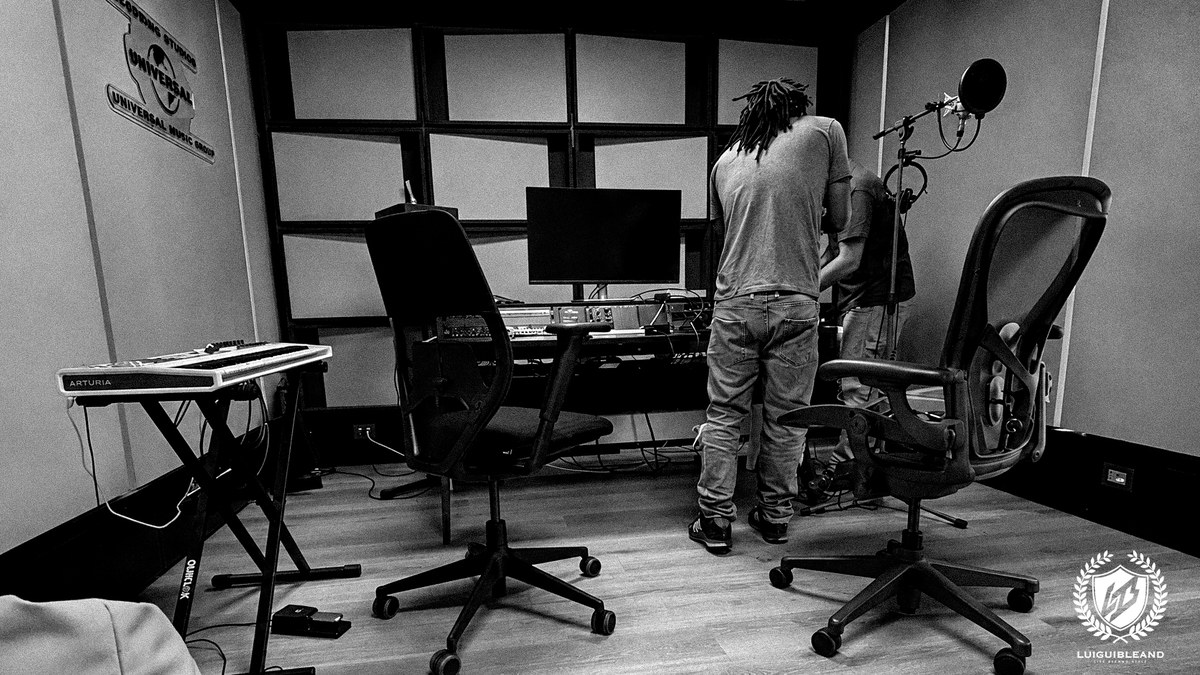
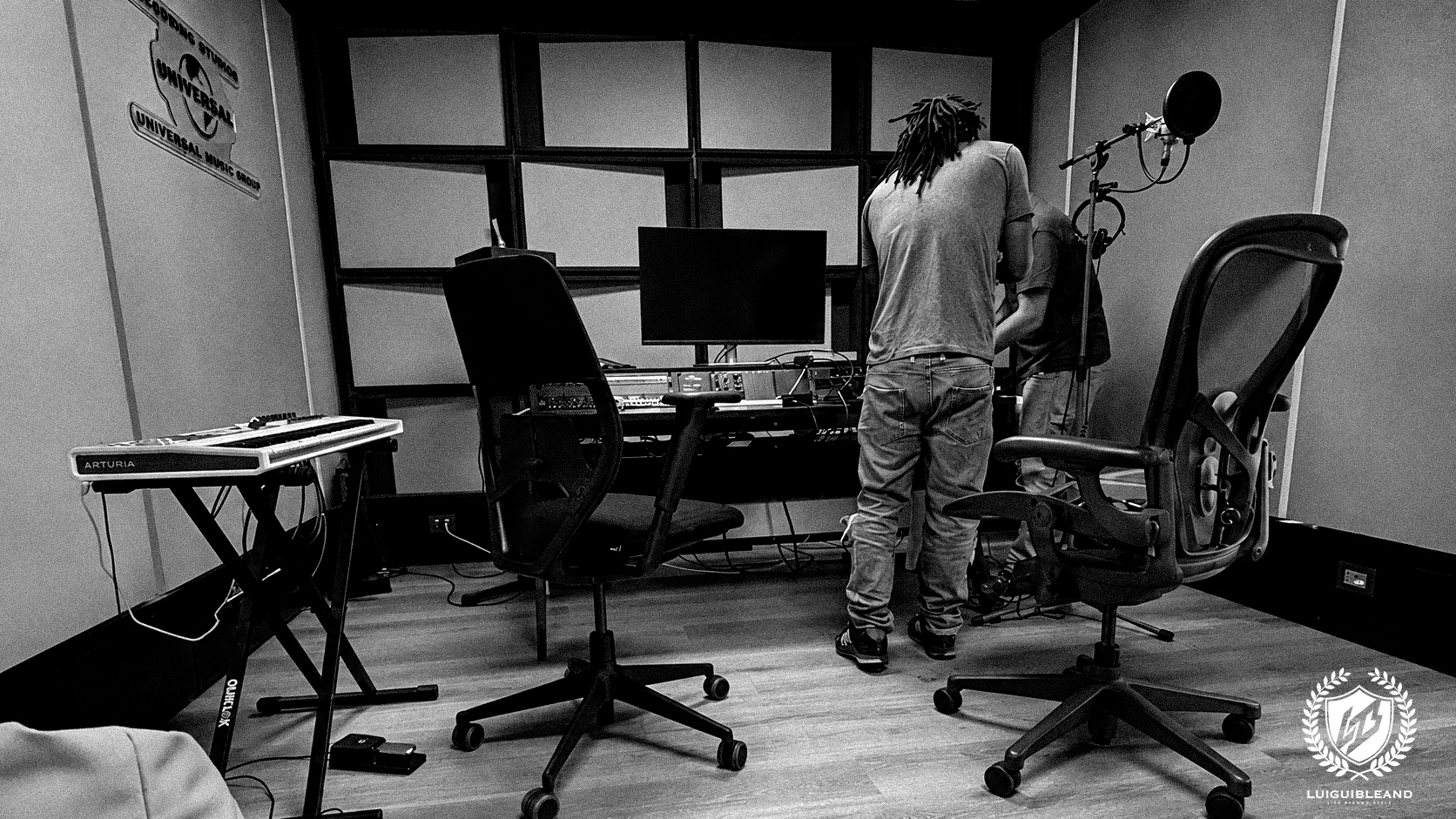
MILAN, ITALY — In a recording room at Universal Music Studios, acoustic panels fill the shelving behind the desk and the studio’s sign hangs on the wall. A microphone is set on its stand, pop filter in place; a keyboard sits to one side; two office chairs are empty. Luigui Bleand stands at the desk with his back to the camera, his head bowed towards the equipment. Beside him, another person works.
There is no stage and no audience in the frame. At these studios, the Dominican artist, producer and entrepreneur, based today in Milan, is completing his new album, “GOAT”, now in its final stage. Focus is easy to name and hard to sustain. In this image it can almost be seen: a person turned towards what he is making, not towards the camera.
What is being built at that desk has an origin older than any session: the dream Bleand works for began when he was a child. Discipline is also a way of keeping faith with the child he was, and of tending that dream with an adult’s care.
In music, discipline is rarely visible from outside. It lives in the parts of the process no one hears: the take recorded again, the level moved by a fraction, the arrangement trimmed until it holds. It is a principle of the craft, practised daily whether or not there is anything to announce. An album like “GOAT” asks for exactly that. Produced entirely by Bleand and producer Marisa de Filippis, it brings together more than seven rhythms and influences, from traditional merengue to urban music. Keeping that range within a single record is itself an exercise in focus.
Sometimes focus means choosing what to set aside. In December 2024, Bleand announced an open-ended pause in his music career to turn his attention to creative and business areas outside the entertainment industry. As reported at the time, after more than a decade in music he wanted to renew his creative drive and explore business models away from market pressure. It was a deliberate decision. His official channels stayed active and, in January 2026, during the pause, he released “Todo Se Olvida”, the first single of the new era.
In early 2026, in Milan, Bleand and Marisa de Filippis founded Siamo Arrivati – Italian for “we have arrived” – a music production company whose stated vision is to create music, entertainment and new creative environments through technology and superintelligence. “GOAT” is the company’s current production, and on the album Bleand has relied on technology to develop and refine the sound. After many years of work, continuing to learn is part of discipline too: bringing new tools to a long-practised craft is one way of keeping it open.
Any work sustained over time meets obstacles, and most of them are quiet. They can change the order of things; they can make a choice necessary. What they cannot decide on their own is the direction of a working life. Overcoming them is rarely dramatic: more often it means returning to the work the next day, at a desk like the one in the photograph.
“AM BACK”, an album recorded in the Dominican Republic in 2023, is due very soon; no date has yet been announced. “GOAT”, in its final stage, still has no release date or final tracklist. Patience belongs to the same discipline: it lets each record find its moment, without hurrying it.
Constancy is easier to see from a distance. In September 2026, an official statement from his communications team confirmed Bleand’s return to the music industry. By his own count, he returns with fifteen years of records behind him, from the first Dominican mixtapes to what he describes as the catalogue era. Across those years, constancy looks like continuity: the work keeps growing, one record after another.
What remains is the image from the beginning: the microphone in its place, the empty chairs, Bleand with his back turned and his head bowed over the work. The first single of this era is titled “Todo Se Olvida” – in English, “everything is forgotten”. The photograph from Milan suggests one exception: that child’s dream, kept each time the man he became returns to the desk.