Luigui Bleand: Time Never Comes Back, and Wasting It Means Losing Dreams
Luigui Bleand writes in his diary about time: what his visit to the Patek Philippe Museum left him with, why every watch shows the same hour even though they do not all mean the same thing, how we measure and perceive time, what the research says about time and money, and why wasting it means losing dreams.
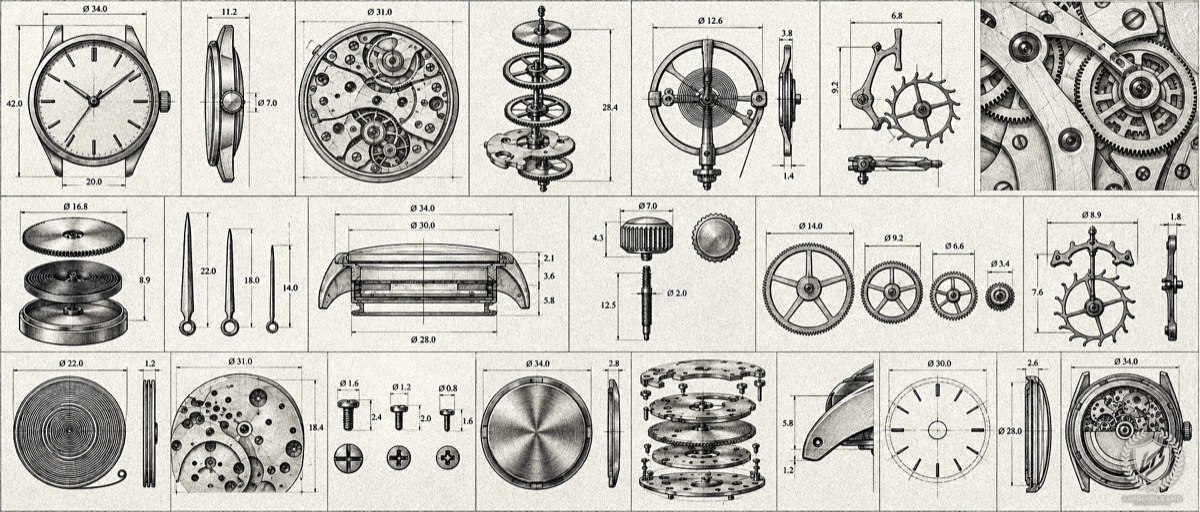
ROME, ITALY — This 4 October I was at the Patek Philippe Museum and saw its history from beginning to end. I came out thinking less about the watches than about what they measure. Everything in those cases, from the first portable watches of around 1500 to those of today, was a human effort to bring order to something that cannot be held: time. That is why I want to write about it – about how valuable it is, how we perceive it and what we lose when we let it slip away on things that make no sense.
The story begins in Geneva in 1839, when Antoine Norbert de Patek, born in Poland, founded the firm Patek, Czapek & Co. with Franciszek Czapek. In 1845 he was joined by Adrien Philippe, who in 1842 had invented a way of winding a watch from the crown, without a key; in 1851 the firm became Patek, Philippe & Cie. Since 1932 it has been run by the Stern family. The museum, created by Philippe Stern after forty years of collecting watches, opened in November 2001: some 2,500 pieces from five centuries, a workshop where restoration is done by hand and a library of more than 8,000 publications devoted to time.
What made me think most was the effort. The pocket watch commissioned by Henry Graves Jr. was delivered in 1933, with 24 complications and 900 parts, and took almost five years to complete. In 1989, for the brand’s 150th anniversary, they presented the Calibre 89, with 33 complications and 1,728 parts. There are perpetual-calendar watches that already know how many days each month has and when a 29 February is due, and need no correction until the year 2100. Years of work by people with enormous experience, to measure the same thing any alarm clock measures.
And that is the curious part. Every watch marks the same time, the time human beings defined, no matter how it is made. A very valuable one will have better materials, stones, gears and finishes, made by people with years of craft, but it does not work any differently: the hour is the same. What changes is what it represents. Often people invest in an object like that not because it measures time, but because of what it identifies: exclusivity, a class, a level of well-being. I measure my time, but that time is in turn measured by an instrument of value, and around that a whole world of excellence is born. I look at it with respect. The house itself sums it up in a line from its advertising: “You never actually own a Patek Philippe. You merely look after it for the next generation.”
But what is time? Sometimes I think it is something undefined, ephemeral, that human beings gave themselves in order to have order. We see the sun rise and set, and the stars change with the seasons, but the way of measuring it was decided by us. The cycle of the seasons lasts about 365.2422 days, a figure no calendar can fit exactly; that is why leap years exist. Even so, it had to be corrected: in 1582, with the reform of Pope Gregory XIII, ten days were removed, and 4 October was followed directly by the 15th. A 4 October, like the day of my visit to the museum. Even the seasons are an agreement: meteorologists start them on the 1st of the month, while astronomical spring arrives with the equinox, a date that shifts a little every year. In summer we have one hour more and in winter one hour less. Time, as we measure it, is partly a perception. What is not an agreement is that it passes, and that it does not come back.
In each person’s life, time is subjective too. We often think “I have no time”, and it is a mental limit: if you make the effort, you arrive in time for the appointment, the goal, the person. In 2012, in Psychological Science, Cassie Mogilner, Zoë Chance and Michael Norton explained it in four experiments: objective time cannot be increased, because the day has 24 hours, but the feeling of having time can. People who spent a while on someone else felt they had more time than those who used it on themselves, wasted it or were given free time as a gift. These were short tasks, with strangers: they measure the feeling, not real hours.
I believe time depends on the importance we give things. “I have no time to go to the gym”, but there is time to spend three hours on the sofa doing nothing. When you really want something, you make the time even when you are tired: you leave work exhausted, but you go and pick up your child and do the homework together, because that time creates memories. Even the speed at which we feel the hours pass depends on what we are living. In 2016, in Frontiers in Psychology, Sylvie Droit-Volet and John Wearden asked 27 people in France, eight times a day for five days, how they felt time was passing: it ran faster when they were happy or absorbed in what they were doing, and dragged when they were sad, with no relation to the clock. It is a very small sample, and the authors call for more studies.
Now, what I most wanted to check: whether it is better to lose money than to lose time. I looked into it and I will say it as it is: the studies do not say exactly that. In 2017, in PNAS, Ashley Whillans and her colleagues brought together surveys from several countries: of 4,469 people, 28.2% paid each month for others to do tasks they did not enjoy, and those people said they were more satisfied with their lives, regardless of their income. In an experiment with 60 adults in Vancouver, on the day they spent 40 dollars on something that saved them time they ended up in a better mood and less rushed than on the day they spent it on a material thing. The authors caution that the effect is modest and that almost all of it is correlation.
In 2019, in Science Advances, Whillans, Laura Macchia and Elizabeth Dunn followed more than a thousand students finishing university in Vancouver. 61.7% preferred to work fewer hours even if they earned less; a year later those students were somewhat happier, partly because they spent more time on things they did for enjoyment, not out of obligation. The authors make clear they cannot prove this causes happiness and that the link is small. So the honest version is this: losing money is not better than losing time, but those who put their time first tend to choose things that leave something behind. And money can often be earned again; time, never.
Time has also taught me many lessons about who are friends, who are not and what each person wants. In 2014, in the International Journal of Behavioral Development, Tammy English and Laura Carstensen followed adults aged 18 to 94 in California for ten years: with age the circle grew smaller, but what was lost was mostly distant contacts; the close people stayed. It was a small sample and many left the study. Carstensen proposes that when we feel time is limited, we prioritise what is meaningful. This is how I live it: time teaches you who they are.
The moment you are living now you will not have again in the same way, in the same conditions. That is why I do not want to chase things that in the end will leave nothing: wasting time means losing dreams. Rest when you need to, but do not give away your hours to what does not build you. Make time for what you love even when you are tired, and look after those who stay. A watch, whether an alarm clock or a museum piece, only tells you what time it is; what you do with that hour is up to you. Time puts each thing in its place, little by little. Live every step of the process.