Luigui Bleand: When the Food Runs Out, How Far Will Humans Go?
The science of starvation, the psychology of fear and envy, and the extreme decisions that challenge our idea of civilisation.
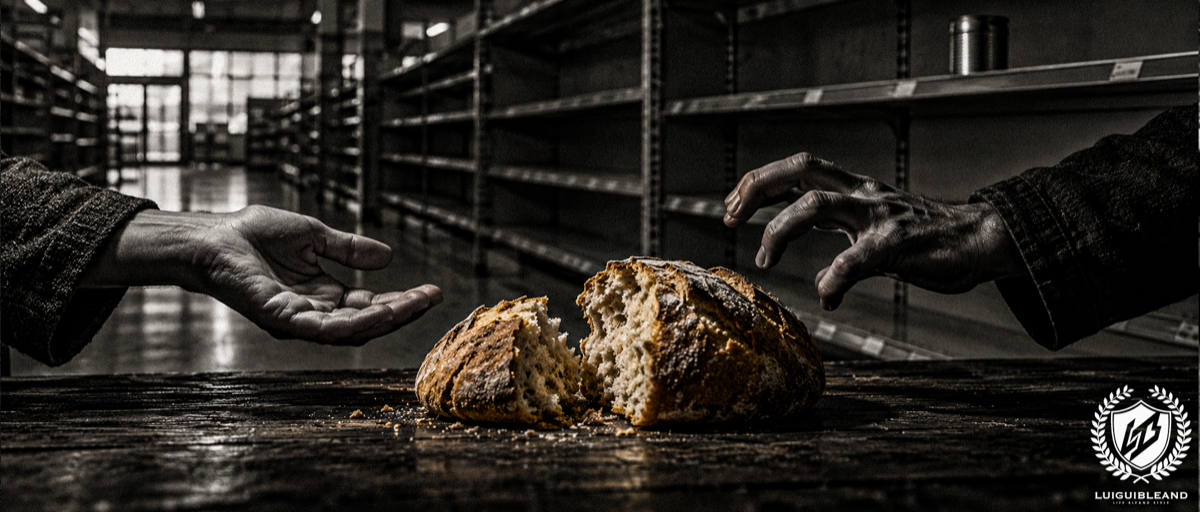
Imagine a world where food no longer arrives
ROME, ITALY — The supermarkets are empty. No supply lorries arrive. The power goes out, communications fail and nobody can say when normal life will return. At first, people try to buy, share or store what little is left. Then the uncomfortable questions begin: who gets the last ration? How long can we hold out? What happens when fear is stronger than the rules?
The scene seems lifted from an apocalyptic film, but famines, shipwrecks, accidents and disasters have shown that extreme deprivation can pose real dilemmas.
One question is especially disturbing: what changes does a person go through before reaching a decision that, under normal conditions, they would consider unthinkable?
The answer is not as simple as “hunger awakens a beast”. Biology explains how the body obtains energy without food; psychology shows how emotions and attention change; history reveals that, even under extreme pressure, there are people who cooperate, protect others and hold on to their moral principles.
First, a clarification: there is no inevitable path to violence
It is tempting to imagine six fixed phases that begin with hunger and end in cannibalism. Science does not recognise that sequence as a universal law. The stages presented below are a narrative tool, not a clinical scale, for ordering physical, psychological and social responses that may appear, overlap or never happen at all.
Three different situations must also be kept apart: feeling hungry, living through prolonged undernutrition and entering a social collapse in which resources are fought over. They are not equivalent. A community can experience fear and conflict before its members are clinically undernourished. And a severely weakened person may lose the physical capacity to act aggressively.
The six possible stages of an extreme food crisis
1. The alarm: when fear arrives before hunger
The first threat may be psychological. News that supplies are running out triggers emergency buying, uncertainty and the need to protect one’s family. Some try to control the supplies; others turn to neighbours, the authorities or support networks.
At this point the body may still have enough energy. What has changed is the perception of the future: the person no longer knows whether they will eat tomorrow.
Key point: the fear of scarcity can trigger tensions before there is any starvation.
2. What happens to your body when you don’t eat? It uses its reserves
When we stop receiving food, the body does not shut down straight away. First it uses stored energy, including glycogen in the liver. As the hours pass, it makes more use of fat and produces more ketone bodies, which can serve as an alternative fuel.
A review published in Obesity places the so-called “metabolic switch” generally between 12 and 36 hours after a person stops eating, although it depends on their initial reserves and on physical activity. That switch does not mean that someone is starving to death at 36 hours, or losing their mind.
Over time the body also uses its own proteins, and keeping vital functions going becomes progressively harder if not enough food arrives.
3. Fixation: when food takes over the mind
Prolonged deprivation does not only affect the stomach. Thoughts can become focused on food: how to get it and when the next meal will be. And the suspicion may arise that others are hiding food.
Irritability may increase, and apathy (a lack of interest and motivation) and social withdrawal may set in. These changes were documented in the Minnesota experiment, which we will return to later: its volunteers, on a semi-starvation diet, also showed a preoccupation with food and even collected recipes and cookbooks. Even so, these reactions are not the same in everyone: age, previous health and the circumstances of each case can make a difference.
The loss of food can also become a loss of calm, of routine and of trust.
Envy: when the problem is no longer how much I have, but how much the other person has
When food starts to run short, a silent question may arise: why does he have more than I do? This is no longer about the envy that appears when someone moves up in life or at work, but about the kind that arises over a ration. Hunger does not only empty the stomach; it can also change our mood. A 2022 study asked 64 adults in Central Europe, mostly women in Austria, to record five times a day, for 21 days, how hungry they were and how they felt. The hungrier they said they were, the more anger and irritability they reported, and the less pleasure they felt. It is an association, not proof of causation, and it concerns everyday hunger, not a famine.
Envy is born of comparison, the same comparison that leads us to keep looking at the neighbour's grass. Psychology describes it as the discomfort of seeing in someone else what we want for ourselves, and some experiments suggest that this urge to “want what the other has” comes on more strongly when our capacity for self-control is taxed or depleted. In the laboratory, for example, people were kept busy with another mental task while they watched someone taste food better than their own. That line of research, however, is still under debate.
Envy also has two faces: a “benign” one, which pushes us to make an effort to catch up with the other person, and a “malicious” one, which wishes the other person ill. In a study of 370 runners at the Cologne Marathon, those who leaned towards the first set themselves higher goals and ran somewhat faster, while those who leaned towards the second more often gave up on setting a concrete goal. It is a correlational study, and the distinction is still debated.
In an empty pantry, the second face may be the more dangerous one. What can feed it is not only the lack of food, but also suspicion: believing that someone is hiding something, that the sharing is unfair, that the rules are not the same for everyone.
We know of no study that has directly compared sharing out food in full view of everyone with sharing it out in secret. But a review of 91 studies of communities that share forests, fisheries, pastures or irrigation water, in the tradition of Elinor Ostrom’s research, found that the systems that last tend to have clear boundaries on who may use the resource, monitoring by the users themselves and low-cost ways to settle disputes. So it seems reasonable to think that a group that shares out food in full view and with clear criteria gives less cause for suspicion than one that does it in secret. What seems to protect trust is transparency in the rules, not just putting on display who gets more.
Envy is not an inevitable phase of hunger. It is an alarm: it warns that trust is breaking down. And trust, like food, can also be shared.
4. Social tension: compete, negotiate or cooperate
In an isolated group, how the rations are shared out can become the central problem. Should everyone receive the same? Should children, the sick or those seeking help come first? Who decides?
Scarcity can encourage suspicion, hoarding or disputes, but it can also strengthen cooperation. Research on collective behaviour in disasters shows that mutual aid is common and that the image of inevitably violent crowds is exaggerated.
There is an important limit: much of that research looks at evacuations and emergencies, not months of absolute famine. Its findings challenge the myth of automatic chaos, but they cannot predict every crisis imaginable.
5. Deterioration: when the body loses the strength to survive
If the lack of nutrients continues, there may be loss of muscle mass, intense weakness, apathy, a feeling of cold, impaired mental function and greater vulnerability to infections. In severe cases the heart, the body’s defences and other organs can be affected.
Here lies a paradox that films tend to overlook: a severely undernourished person loses muscle mass and strength, and may be too weak to fight. They do not necessarily become stronger, fiercer or more dangerous. In many situations, what dominates may be exhaustion and apathy.
There is no number of days that guarantees this stage for everyone. An illness, the temperature, age, the amount of water and the degree of deprivation change the outlook radically.
6. Decisions at the limit: survival, ethics and exceptional acts
History records situations in which some people, after being completely isolated and without food, resorted to eating human remains. This is what the forensic literature calls nutritional cannibalism, popularly known as survival cannibalism.
But there is an essential distinction: eating the body of someone who has already died is not the same as killing another person for food. The two scenarios raise profoundly different human and moral problems.
Nor is there a medical “sixth phase” that automatically turns hunger into cannibalism. That behaviour is exceptional and depends on extreme circumstances, social relationships, beliefs and individual decisions.
How long can you survive without food… and without water?
When we imagine a catastrophe, we tend to ask how long someone can survive without food. But if drinking water disappears too, the threat can become serious much faster. As a guide, without food but with water, total starvation is usually fatal in about 8 to 12 weeks; without water, by contrast, survival is measured in days.
Severe dehydration can cause dizziness, confusion, a drop in blood pressure and damage to vital organs. That is why it is misleading to propose a single timeline for the “apocalypse”: a community without food but with water is not the same as people exposed to heat with no way of staying hydrated.
Nor is there an exact survival time that applies to everyone: the figure of 8 to 12 weeks without food is only a guide, because the duration varies greatly from one person to another. Besides energy reserves, environmental conditions such as heat play a part, as do each person’s health and age.
Who would hold out longer: someone who eats a lot or someone used to eating little?
Eating large amounts every day does not mean a person will be the first to lose control. Nor does eating little guarantee better adaptation.
Physical endurance depends, among other factors, on body composition, energy reserves, muscle mass, nutritional status, hydration, illness and the activity the surroundings require. Emotional tolerance depends on other variables: past experiences, social support, uncertainty and strategies for coping with stress.
It is worth avoiding a simplistic conclusion: a person’s usual appetite does not predict who will become violent or how long they will last without food.
The Minnesota experiment: when science studied hunger
During the Second World War, the researcher Ancel Keys and his team studied the effects of prolonged food restriction at the University of Minnesota. Thirty-six men volunteered to help build knowledge about undernutrition and about the recovery of people affected by the war.
The protocol included 24 weeks of semi-starvation, that is, a very reduced diet (around 1,600–1,800 kilocalories a day), but not a total absence of food. Many participants lost around a quarter of their body weight. Fatigue, irritability, apathy, weakness and other physical and psychological changes were documented.
The study taught something fundamental: a sustained lack of energy can transform emotional state and behaviour, even in people who were initially healthy.
What the experiment did not show is that starvation inevitably leads to murder or cannibalism. Nor does it reproduce all the conditions of a catastrophe: the volunteers were supervised and knew they were taking part in research.
The Andes tragedy: a real case that forces us to think
On 13 October 1972, a Uruguayan plane crashed in the Andes. Isolated on the mountain, in extreme temperatures and with very little food, the survivors had to make decisions they had never imagined.
After 72 days, 16 people had survived the tragedy. Part of their survival was linked to eating the bodies of companions who had already died.
This detail is essential to telling the story correctly: the case should not be presented as a group that began killing one another to eat. The story also includes organisation, care for the injured, the building of shelters, shared decisions and the extraordinary effort of those who set out to find help.
The episode shows that extreme survival can force people to rethink moral limits, but it does not prove that human beings are destined to become predators when the food runs out.
Does civilisation disappear when the food disappears?
An apocalyptic view suggests that laws, education and empathy are a thin layer that breaks as soon as supplies fail. Reality is more complex.
Studies of emergencies often describe spontaneous help between strangers. The psychologist Jamil Zaki, of Stanford University, calls this phenomenon “catastrophe compassion”: the acts of solidarity that emerge in the middle of a crisis.
That does not rule out conflict. Fear and inequality can make tensions worse, and so can rumours: after Hurricane Katrina, exaggerated accounts of looting led the authorities to put control ahead of humanitarian aid, even though most of those affected remained peaceful and many helped one another. But it is important to distinguish a possibility of violence from a biological need to be violent.
Perhaps the most revealing question is not “at what point do we become animals?” but “what conditions lead us to care for others, and which ones erode our ability to do so?” Moreover, the expression “animal violence” is a metaphor, not a scientific category: in many species a lack of food increases aggression over food, but many animals also cooperate and care for others.
An imaginary scene: twelve people and an empty pantry
Let us imagine twelve people sheltering in a building after a catastrophe. They have drinking water, but their food supplies are about to run out.
One group proposes sharing everything out equally. Another thinks that those who are ill should receive more. Someone fears that a person is hiding food. Someone else decides to share a ration with a stranger.
They all feel the same general threat, but they do not react in the same way. Uncertainty produces different economic, social and moral decisions. Conflict may appear, but so may a better organisation of resources.
This scene is hypothetical, not the description of an experiment. It serves as a reminder that the human response is not written by the stomach: it also depends on the relationships and rules that a group manages to build.
The ultimate question: how far would we go to stay alive?
Hunger alters metabolism, attention, physical strength and emotional state. In extreme circumstances it can create conflicts that are hard to imagine from the comfort of a normal life. But there is no universal countdown that ends in violence, nor any scientific threshold beyond which people automatically lose their principles.
History teaches two truths at once: human beings can commit extraordinarily disturbing acts to survive, and they are also capable of sharing the last thing they have.
Perhaps the border between civilisation and barbarism lies not in the amount of food we have left, but in the decisions we make when it starts to run short.
Do you think a person keeps their principles when their life depends on a last ration? Or do you think survival ends up overriding everything else?