Luigui Bleand: The Rope
Luigui Bleand writes in his diary about a cut rope, the footprints that keep going and a calm sentence: “I don’t owe you the story of how I survived.”
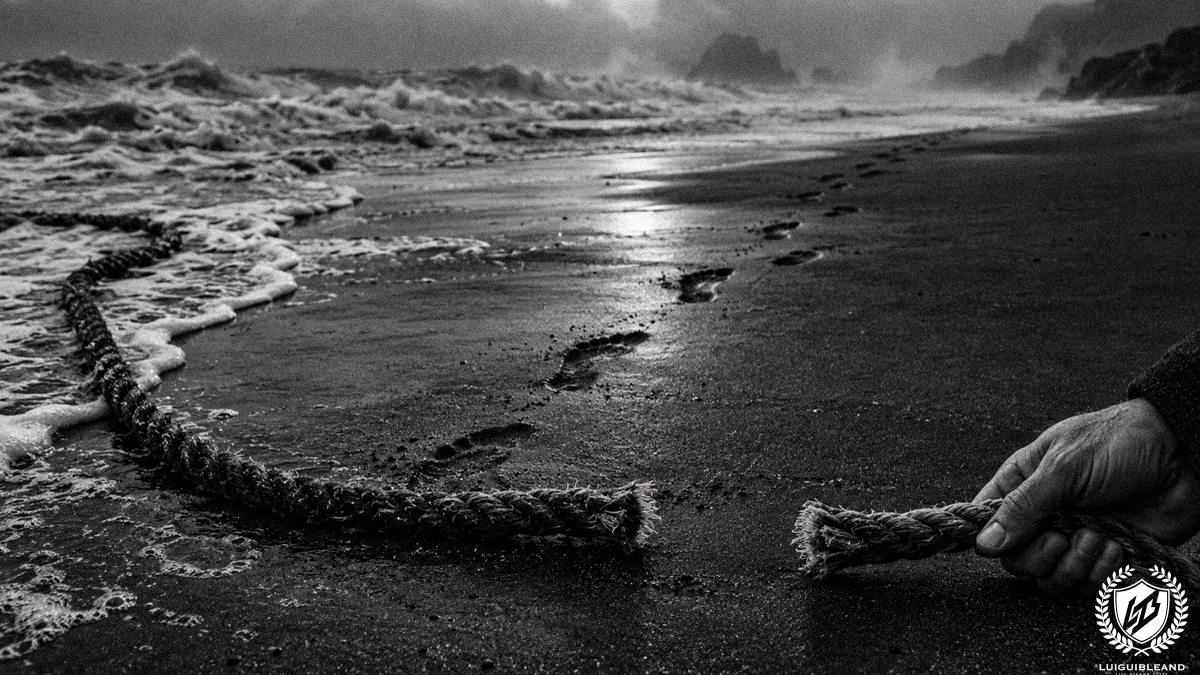
ROME, ITALY — The sea is rough. Everything is grey: the sky, the waves, the wet sand. On the shore lies a thick rope, cut in two. One end has been left at the water’s edge, frayed, and each wave covers it and leaves it behind again. The other is still in a weathered hand that holds on to it, like someone who cannot quite believe there is no one left on the other side. And further on, along the beach, a line of footprints moves ahead, step by step, until it disappears into the mist.
That rope was a bond, and a rope like that does not break on its own: someone cut it at the hardest moment, just when it most needed to hold. That is how many people’s stories begin: one day you discover that someone you counted on decided to let you go, and not when everything was going well, but when you were sinking. It hurts in a particular way, because you do not only lose someone: you also lose the idea you had of that person, and for a while you even doubt your own good sense. But the footprints say that, after the cut, there was a path.
Rebuilding does not begin with courage; it begins with fear. Fear of trusting, of being let go again, of not being able to get up. And often, with someone who did stay: the one who called before you asked, who sat beside you without asking questions. In 2009, in the Journal of Loss and Trauma, Gabriele Prati and Luca Pietrantoni brought together 103 studies on post-traumatic growth, the positive changes some people describe after a very hard crisis. Having social support, and also seeking it out, was moderately related to that growth. The data are correlational, from people who had lived through trauma, and the growth was self-reported. This is how I read it: accepting help from those who stayed takes nothing away from your getting out; it is part of how people get out.
Then comes the slowest part: trusting yourself again, trusting that you know how to walk without that rope. In 2016, in Perspectives on Psychological Science, Frank Infurna and Suniya Luthar reanalysed 28 years of a large annual survey in Germany, tracking life satisfaction from five years before to five years after blows such as a divorce. With models that let each person change at their own pace, for divorce the share of people who seemed stable was no longer the 72% reported earlier but 36%, and 64% probably went through a sharp drop followed by a slow recovery over the following years. The authors warn that these figures depend heavily on the statistical model. If it took you time, I would not call that weakness: in that analysis of divorce, slow recovery was the most frequent pattern.
And one day, when you are already back on your feet, some of the people who stepped away come back. Sometimes with genuine affection; sometimes with simple curiosity. They want to know how you got out, who helped you, how you rebuilt your life. There is no need to think badly of anyone for asking. But it is worth being clear about one thing: having been part of your past does not give anyone the right to demand access to who you are now. They saw you fall, but they were not there while you were learning to get up. You walked that part of the road with other people, or alone, and only you decide whom you tell about it.
At the centre of it all there is a simple idea: your story is yours. One phrase sums it up, and it can be said quietly: “I don’t owe you the story of how I survived.” In 2020, in Current Opinion in Psychology, Sandra Petronio and Jeffrey Child reviewed communication privacy management theory. According to it, people believe that their private information belongs to them and that they have the right to control it: they decide whom to make an “authorised co-owner” and by what rules of their own to open or close access. The authors acknowledge that revealing something private can leave you feeling vulnerable, and that having even a sense of control can temper that feeling. It is a theory about what people believe, not proof that keeping quiet leads to better outcomes. This is my own reading, not the theory’s: having once been close does not give anyone a place inside the story of how you got out.
This is not about keeping it all to yourself, or telling it all. In 1996, in Psychological Bulletin, Anita Kelly and Kevin McKillop reviewed what was known about revealing personal secrets. Most of the published work suggested that telling them helps, but they warned that revealing is a complex decision: it can bring rejection from the listener and, with it, a negative self-image. They concluded that there are many circumstances in which it is better not to reveal, and that the listener’s response, real or perceived, plays a key role in whether telling helps. In 1999, in Current Directions in Psychological Science, Kelly put it this way: deciding wisely depends on finding someone discreet, who you feel will not criticise you and who can offer you a new perspective. They deal with secrets, not with stories of recovery; my own reading, not theirs, is that what matters is less how much you tell than whom you tell.
And then there is the door. I have already written in this diary about the forgiveness Jesus asked for from the cross, so one line is enough here: forgiving whoever cut the rope does not oblige you to hand them the key again. In 2010, in the Journal of Personality and Social Psychology, Laura Luchies, Eli Finkel, James McNulty and Madoka Kumashiro published four studies with newlyweds and university students in the United States. Pooling three of them, they found that forgiving someone who had barely done anything to repair the harm was associated with less self-respect and less clarity about one’s own identity; forgiving someone who had made real efforts to repair it, by contrast, strengthened both. They called it the “doormat effect”. In one of them, the imagined offence touched this subject very closely: that your partner told a mutual friend very private details you had confided only to them. Everything was self-reported, in relationships that were still ongoing, and the authors warn that their results may not apply to people who were close in the past, as in this story. That the door reopens because of what the other person does, not because of what you tell them, is my conclusion, not the authors’.
Setting that limit is not revenge, and it needs no scene. You can be truly glad to see that person doing well and still tell them nothing; you can say “thanks for asking” and change the subject. Silence, when it comes from peace and not from resentment, is also a dignified answer. And if one day you decide to tell it, let it be because you want to: sharing the road you walked can be a gift; demanding it never is. Keep the full story, with its long nights and its small steps forward, for those who were there, and name those people, one by one, in your prayers. With them, no explanations are needed, and perhaps that is exactly why they are the first to hear it.
Look at the shore again. The hand still gripping the cut end is the first day, and there is no need to pretend it never happened. The footprints moving away are all the days that came after: a life rebuilt little by little, with fear and with help. Whoever did not walk those steps with you can see them from afar, but cannot demand the map. And if one day someone who let you go comes back and asks you to explain how you got out, you can answer calmly and with your head held high: “Having watched me sink does not give you the right to demand that I explain how I learned to get out.”